A Month in the Freezer: My Experiment with the Great British Writing Shed
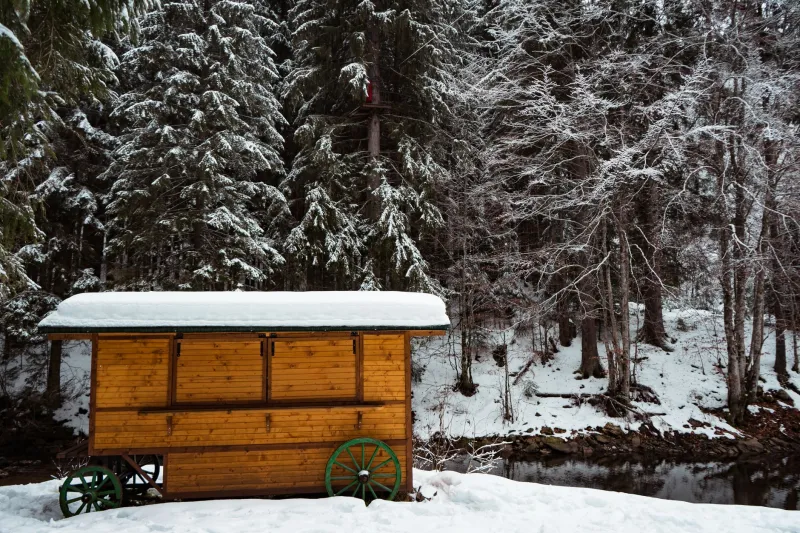
There is a particular kind of British madness that involves looking at a warm house with central heating, a sofa and a perfectly good desk, and deciding that the only place to write a novel is an unheated wooden box at the end of the garden. I know, because I did it. For the whole of November, I drafted in my neighbour's old potting shed, which I'd bought off him for £80 and a promise to take it away. It has no insulation, one window with a crack in it shaped like the River Severn, and a door that closes with the enthusiasm of a man who'd rather be doing something else.
It was, against all sense, the most productive month of my writing life.
A National Tradition of Shivering
We talk a lot about the garret, but the garret is French. Britain's contribution to literary architecture is the shed, and we should be prouder of it. Dylan Thomas wrote at the Boathouse in Laugharne with a view of the estuary and, presumably, a view of his own breath for much of the year. Roald Dahl went further: his hut in the garden at Great Missenden was so sacred that visitors were forbidden, and he sat in a chair with a hole cut in the back for his bad spine, a piece of furniture so gloriously unglamorous it belongs in a museum — which, eventually, it was.
George Bernard Shaw had the famous rotating shed at Ayot St Lawrence, a hut on a pivot so he could follow the sun around the garden like a slightly pretentious sunflower. Philip Pullman built himself one in Oxford. Virginia Woolf had her lodge at Monk's House, which is at least a room, but the principle holds: the British writer, given a house, will immediately seek out the smallest, coldest, most structurally dubious building on the property and declare it the good one.
There's a theory for why this happens. The house is where life happens — deliveries, other people, the washing machine sulking mid-cycle. The shed is a border crossing. You walk twenty feet down the garden and you have, technically, left the country. Your commitments can't follow you across. It's not the cold that makes the shed work; it's the crossing.
Though, to be fair, the cold does something too.
The Experiment, Annotated
My rules were simple: every morning, 8am, shed. No heating beyond what my body and a hot water bottle could produce. Diary-style notes follow.
Week one. Arrogant. Full of energy. Wrote 900 words on Tuesday and told three people about it. The shed smelled of soil and old creosote and, oddly, ambition.
Week two. The novelty of the cold expired. My fingers typed at roughly the speed of a post office queue. I learned to draft in wool gloves with the fingertips snipped off, which looks deranged and works brilliantly. Wrote 400 words one day and considered it a triumph. Discovered that at around 7°C, the brain stops fussing about emails and starts fussing about survival, which is a surprisingly good editorial filter. You only write the sentence you actually need.
Week three. Rain on a shed roof is a sound so loud it should require a licence. I couldn't hear myself think, so I stopped thinking and just wrote. Best chapter of the month arrived on a Wednesday, written almost in a trance, interrupted only by a blackbird who has apparently decided the shed is his second home and watched me work with the judgement of a senior editor.
Week four. The frost came. I opened the door to find my notebook stiff, my water bottle iced and the ink in my pen sulking. I wrote anyway, hunched over like a Victorian clerk, and finished the draft at 11.40am on the 30th, then sat in the cold for another ten minutes because I didn't want to leave.
I should be clear: the shed didn't write the book. But it removed every excuse. There's no tidying to do in a shed. There's no fridge to visit. There's nothing to do but the work, and when the work is done, you go inside and the house feels like a reward. That's the trick nobody mentions — the shed doesn't just make writing better, it makes the kettle better.
In Defence of the Thermos
Which brings me to the true hero of this piece, and possibly of British literature: the thermos flask.
Consider what the thermos actually does. It takes warmth from the house and stores it, in defiance of the weather, for exactly the moment a sentence goes wrong. It requires no electricity, no signal, no subscription. It has no notifications. It is, I'd argue, the most important piece of literary technology this country has produced since the paperback — and unlike the paperback, nobody has ever written a 3,000-word think piece about it, which I am now correcting.
Dylan Thomas had beer and peanuts at the Boathouse, which I respect, but a thermos of coffee at 9am in a frost-bound shed is the more disciplined romance. Mine is a battered green flask I inherited from my dad, who used it for fishing and never once for writing, and I like to think it approves of its second career.
Come Spring, I'll Stay
The plan was always to move back inside for winter proper. It's December now, and I haven't. I've bought a second-hand oil heater, nailed a rug to the floor as insulation and hung a fairy light, because apparently even the ascetic life needs a little sparkle.
So if you've got a shed — or a garage, or a box room, or a corner of anything that isn't quite the house — I'd say this: the great British novel isn't written despite the cold room at the bottom of the garden. It's written because of it. Fill the flask. Take the gloves. The blackbird will keep you honest.