She Spotted a Split Infinitive and Missed the Murder: My Nan, My Manuscript and the Problem with Family Beta Readers
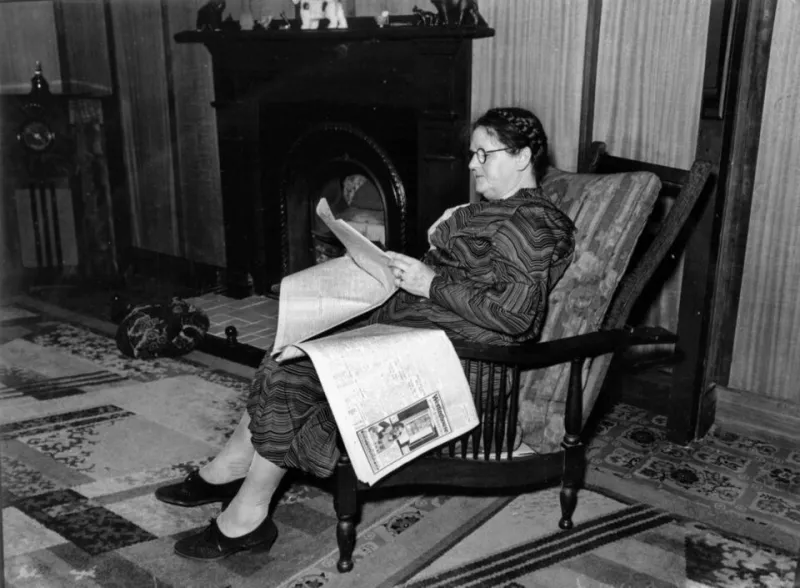
Photo: Unknown, Public domain, via Wikimedia Commons
My nan read the whole of my first novel in eleven days. She was eighty-one at the time, partial to a crossword and a sherry, and she'd never shown the slightest interest in contemporary literary fiction. I handed her the manuscript in a ring binder, hands slightly clammy, and told her to be brutal.
She was brutal. Just not about anything that mattered.
The Red Pen of Love
When the folder came back, it was annotated from cover to cover in Biro. She'd corrected my grammar — genuinely, there's a split infinitive on page one that I've never fully forgiven myself for. She'd circled every instance of 'which' where I'd meant 'that'. She'd flagged a character called Gillian because she once worked with a Gillian who 'wasn't to be trusted'.
What she had not done, in three hundred and forty pages, was mention the plot. Not once. Not the murder in chapter four, not the marriage falling apart in chapter nine, not the ending I'd rewritten six times and still wasn't sure about. As far as my nan was concerned, the book was about punctuation, and I had a real gift for commas.
I rang my mum to gently take the mickey, and my mum said: 'Well, she thought it was lovely. She's telling the whole of the WI.'
And that's the thing, isn't it. That's the whole problem in one phone call.
Why the People Who Love You Can't Help You
A beta reader has one job: to tell you the truth about the reading experience. Did it drag? Did they care? Did they put it down and fail to pick it back up? To do that well, they need two things in generous supply — honesty and distance — and the people closest to us have neither.
Your mum can't be honest because her loyalty is absolute. Your best mate from the pub might manage honesty but not distance, because they can only ever see the book through the lens of you. And your nan, in my case, simply read the novel as an extension of her grandson: a long, occasionally rude letter from Liam, to be enjoyed for its existence rather than judged on its merits. Correcting the grammar was her way of loving it. She was, in her fashion, contributing.
There's a darker version too, which I suspect many writers will recognise. Some relatives read your work not as a book but as evidence. My uncle got as far as chapter six before asking, over a Sunday roast, whether the awful father character was 'based on anyone we know'. It wasn't. But the question ended the conversation about the book permanently, and I learned never to hand him anything again.
The truth is that family beta readers give you feedback on yourself, not the manuscript. And you cannot revise yourself.
What I Do Instead Now
It took me two more novels to work out a system, but I've landed on something that actually functions. Think of it as a rotation, a small squad with distinct jobs.
The structural reader. One person — in my case a friend from my writing group who's merciless in the kindest way — gets the messy draft and is only allowed to comment on big things. Does the middle sag? Is the ending earned? No grammar notes permitted. I once banned her from owning a red pen for a fortnight.
The genre reader. Someone who reads widely in whatever you're writing. They know the conventions, so they can tell you when you're breaking them badly and when you're breaking them well. My crime-writing friend spotted in one read that my detective was solving things by luck rather than deduction — something my nan would never notice and my mum would never mention.
The stranger. This is the important one. Someone who knows you well enough to be reliable and not at all well enough to spare your feelings. A friend of a friend. Someone from the group chat who owes you a favour. They owe you nothing, and that's precisely the point.
The reader of pure pleasure. Keep one. One person who just reads for joy and tells you what they loved, because when you're on draft six and full of doubt, you need to remember the book works for somebody. But they go last, never first.
A Word for My Nan
I don't want to end on her as a punchline, because here's the thing: she was doing her best with a job she was never suited for, and she did it out of love. She kept that ring binder on the shelf in her front room until she died, and when visitors asked about it she'd say, 'My grandson wrote that,' with a pride that had nothing to do with the commas.
The lesson isn't don't share your work with family. It's that sharing a manuscript and sharing your work are different things. Let your nan read the finished book, when it's done and strong and can survive being loved unconditionally. Give the rough draft to people who owe you nothing.
And for heaven's sake, check your split infinitives yourself.