Post Offices and Platform 2: Where My Best Ideas Actually Come From
There's a moment I chase in almost everything I write. It usually happens somewhere unremarkable — a bus shelter in the drizzle, a supermarket self-checkout, the fifteen minutes between two trains that should have connected. The moment when ordinary life briefly forgets it's being ordinary, and shows you something true.
People assume writers need dramatic material. Affairs, murders, war. But I've spent years trying to write about big things and producing my worst work. The stories that actually hold together, the ones readers email me about, are nearly always rooted in the small stuff: a woman feeding gulls outside a chippy in Morecambe, the specific silence of a Wetherspoons at 10am on a Tuesday, the man at my local post office who weighs every parcel like it's a personal affront.
The Long British Habit of Looking Closely
I didn't invent this. Nobody does. There's a lineage here that runs straight through Joan Didion's American highways and lands, rather more damply, in Britain — in Laurie Lee walking out of the Cotswolds with a violin, in Alan Bennett's unmissable ear for how people actually talk, in the essays of Jan Morris or the diaries of anyone who ever noticed the weather. Observational writing is practically a national sport. We're a country of annotators. We annotate the queue, the forecast, the state of the pavements.
What I love about the tradition is its democracy. Anyone can do it. You don't need access or connections — you need a window seat on the 38 bus and a willingness to keep your ears open. Some of the best dialogue I've ever overheard came from two teenagers arguing about whether a seagull could beat a heron in a fight. I still don't know the answer. I've thought about it more than some career decisions.
The Platform as a Writing Room
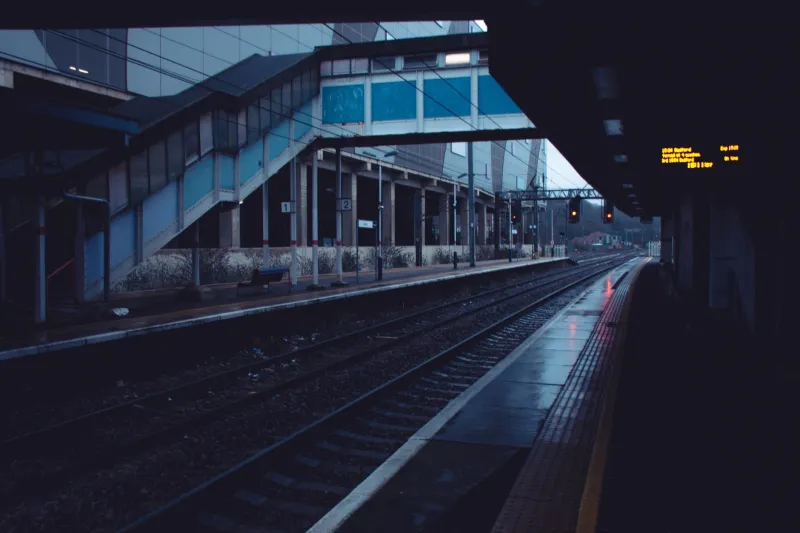
Train stations are my cathedral. Not the shiny ones — the tired regional ones, where the departure board flickers and there's a coffee machine that dispenses something technically legal. A station platform is a cross-section of the entire country compressed into ninety metres. You get the commuter with the exact same coffee order and the exact same resigned expression every morning. You get the couple saying goodbye in a way that tells you the whole relationship's arc in eleven seconds. You get announcements that border on poetry: this service is formed of fewer carriages than usual.
I keep a notes app that is essentially a ledger of these moments. Most will never become anything. But every so often one hooks into something bigger — a story about grief that started with a lost umbrella, an essay about community that began with a bus driver who waited. The mundane isn't the subject. It's the door.
Why Small Places Hold Big Stories
The village post office near where I grew up is now also the off-licence, the parcel collection point, and unofficial counselling service. That single building contains half of what I want to write about: the way British institutions shrink and adapt and keep going out of sheer stubbornness. The woman who runs it knows everyone's name, everyone's deliveries, and, I suspect, everyone's business. If I wrote a novel about a spy, it would be less interesting than her Tuesday.
There's a temptation, when you're starting out, to write about somewhere else. Somewhere bigger, warmer, more cinematic. I did it for years and it read exactly like what it was — a person writing about a place he'd only seen through a screen. The breakthrough came when I stopped apologising for my postcode and started treating it like foreign territory. Really look at your own high street. Notice what's changed, what's survived, who's standing outside the bookies. It becomes strange and vivid the moment you commit to seeing it.
An Argument for Boredom
Here's my actual advice, for what it's worth: get bored more often. Boredom is the price of admission for observation. Put the phone away on the train. Stand in the slow queue. Take the scenic route through the retail park if you must. The writer's most important tool isn't talent or discipline — it's the willingness to be unoccupied long enough for something to wander in.
Britain hands you material constantly. It's in the small talk about the weather, which is never really about the weather. It's in the way strangers apologise to furniture. It's in the allotment, the boot sale, the pub where the same three regulars have occupied the same corner since roughly the Norman Conquest. You don't need to go looking for stories. You just need to be there when they happen, which is always, everywhere, mostly on a Wednesday afternoon.
So no, I don't write about Britain because it's grand. I write about it because it's there — all of it, the lot, every delayed service and every post office queue. The everyday isn't a consolation prize. It's the whole prize, hiding in plain sight, waiting for someone to bother looking.