Refills, Begonias and Anonymity: Why I Drafted Half a Novel Among the Hanging Baskets
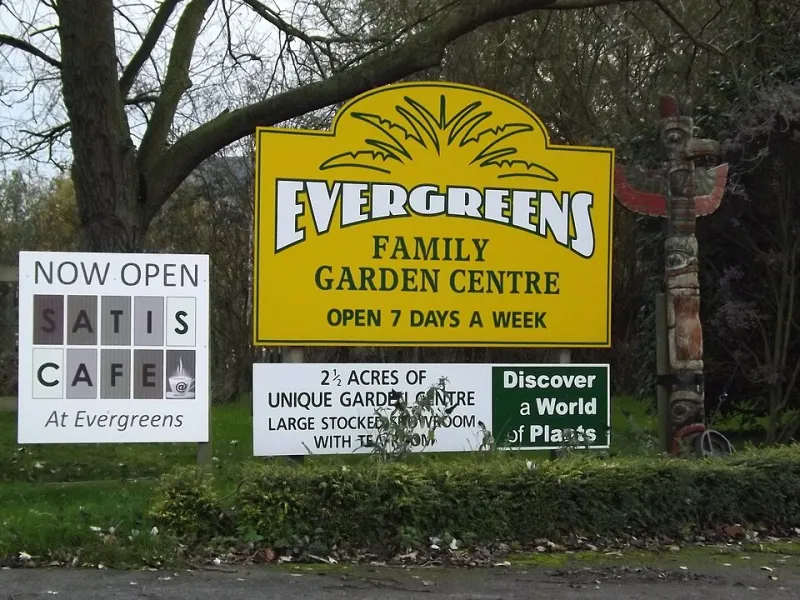
Photo: Geographer , CC BY-SA 2.0, via Wikimedia Commons
There's a particular Sunday ritual that defined most of my thirties, and it wasn't mine. It was my mother's: a drive out to the garden centre, a lap of the houseplants she had no intention of buying, and a pot of tea in the café before the car park filled up with families looking at garden furniture they'd never assemble.
For years I went along as moral support. Then one rainy February, with a deadline looming and my usual café overrun by laptop-hoarding students, I brought the notebook. Ordered my tea. Sat down by the window, next to a tray of winter pansies nobody had bought yet.
And I wrote more in ninety minutes than I had in the previous fortnight.
The acoustics of a good greenhouse
A garden centre café is a strange acoustic space. It's usually a semi-glazed extension bolted onto a warehouse of compost, so the sound doesn't bounce so much as dissipate into the humid air. Somewhere behind you, a trolley squeaks past the bird feeders. There's a low hum from the chiller cabinet where the sandwiches sit. And underneath it all, the particular rustle of polytunnels and plastic plant labels in the shop beyond.
It turns out this is the perfect white noise for drafting. Not silence — silence makes me self-conscious, every clack of the keyboard sounding like a confession. Not chatter either, because you inevitably start eavesdropping on somebody's divorce. But that middle register of ambient busy-ness, where the noise is constant and meaningless, is exactly what my brain needs to stop listening to itself.
I've since noticed other writers there. We never speak. There's a man who does crosswords near the till, and a woman who I'm fairly sure is editing a PhD thesis, judging by the way she reads the same page for twenty minutes. We are all invisible to each other, and that's the point.
Nobody is watching, nobody cares
Here is the thing about the prettier cafés — the ones with exposed brick and oat milk and a barista who remembers your name. Somebody is always looking. Or you feel they are. You become a Performer, Working. You arrange your notebook at a slightly photogenic angle. You take the pen cap off with a flourish you don't notice yourself doing.
At the garden centre, there is no performance possible. The clientele is composed of couples in fleeces discussing slabs, and a steady stream of grandparents buying bedding plants. A forty-something man scribbling in a notebook is, at best, mildly interesting, and more likely entirely unseen. I once wrote a fairly raw scene about a funeral with a family of four discussing a shed two feet away, and I felt nothing but productive.
Anonymity, I've come to believe, is an underrated writing condition. Libraries offer it, but with a hush that can feel like pressure. Garden centre cafés offer it with a full English breakfast and a view of the shrubs.
The economics of the eternal refill
Let's talk money, because writers always are, quietly. A pot of tea at my local place — a large family-run outfit on the ring road, the sort with a Christmas grotto in November and a café that seats eighty — is £2.40. The refill is free. I have sat there for three hours on a wet Wednesday in March for the price of a single flat white in town, and nobody has once given me the look that says are you going to order something else or just occupy the furniture?
The staff have long since worked out what I am. One of them, a woman named Carol who has an encyclopaedic knowledge of when the delivery of heathers arrives, once asked if I was writing a book. I said yes, mostly to avoid explaining. She said her niece was doing a Creative Writing degree in Derby and I should keep at it. It remains one of the more encouraging reviews of my career.
A table by the begonias, always free before ten
There's a practical rhythm to it as well. The café empties out after the early rush — the serious gardeners, the ones who arrive at opening to get first pick of the seed potatoes — and between about ten and half eleven there is a golden window. A table by the window, natural light, the smell of bark chippings drifting in whenever the automatic doors do their thing.
My mother, for her part, has decided this is all a bit odd but tolerable, provided I still walk the aisles with her first. And I do, because the truth is that half the ideas arrive there anyway, somewhere between the compost and the bird baths, when you're not trying. The garden centre sells growth, after all. It's only fitting something of mine took root in the café.
I finished the draft of that novel eventually. The acknowledgements thank my agent, my partner, and — in a line only three people have ever understood — 'the café among the hanging baskets, and Carol, who always kept the pot coming.'
If you're stuck for somewhere to write, skip the city. Find the nearest place that sells lawnmowers and lemon cake. Go before ten. Sit by the begonias. Nobody will bother you, and the tea is free the second time round.