Six Folding Chairs and a Lanyard Colour Chart: A Weekend at the Literary Festival
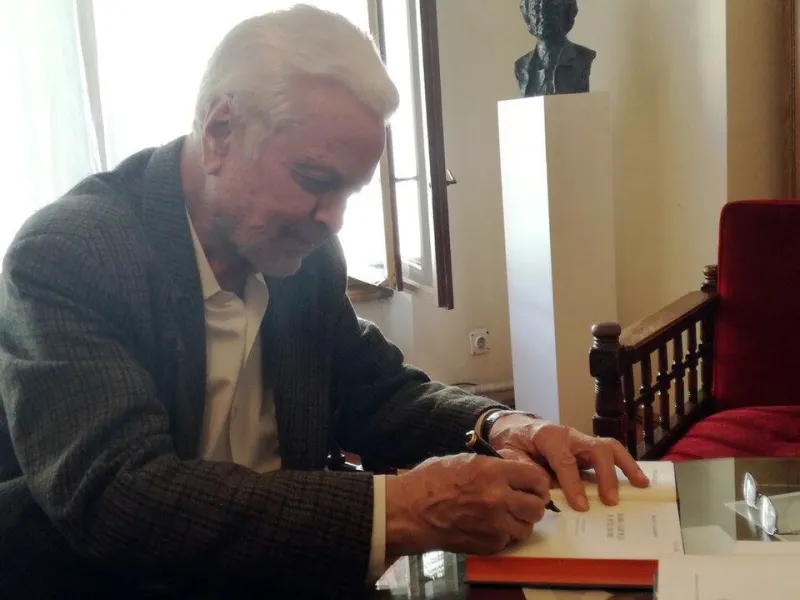
Photo: Viktor Lazić, CC BY-SA 4.0, via Wikimedia Commons
The lanyard arrived in a brown paper envelope four weeks before the festival, along with a car park pass and a photocopied map of a town I had never visited. There is something quietly pleasing about a lanyard in the post. It says: you are expected. It says: somebody has budgeted for you. Then you arrive, and discover the lanyard is also an instrument of social classification, and that yours is the wrong shade of green.
I had been invited as a mid-list author. Two novels in, decent notices, sales figures I have learned to describe in public as 'steady'. My duties were a single panel appearance, an hour at a signing table, and a general willingness to be available. In exchange I got a travel allowance, three nights in a halls-of-residence block that smelled faintly of exam season, and a badge on a string. I have never been so pleased to be so peripheral.
A Colour Chart of Importance
Festival lanyards are a hierarchy you can read at forty paces. Gold, I was told, means patron — someone who has donated a sum of money and would like it acknowledged with a seat near the front. Red is staff, and staff walk quickly with clipboards. Blue is volunteers, who are the only people at the festival doing anything useful and who are unfailingly kind to authors because nobody has told them yet that they don't have to be. Green, in the year I attended, meant author. There were, on my reckoning, eighty-one of us.
Within green there were sub-greens. The names in enormous type had a little star next to their surname on the badge. The rest of us had no star, and spent the weekend squinting at each other's chests in the queue for coffee, working out who outranked whom. It is extraordinary how quickly a grown adult will adopt the instincts of a boarding-school prefect when handed laminated hierarchy.
Six Chairs, Two of Them Occupied
My panel was on the Friday at eleven, in a marquee that had been pitched on what I suspect was normally a rugby pitch. The subject was 'Place and Belonging in Contemporary Fiction', which is the kind of title you get given when the programmer has five authors and four topics.
We had an audience of six. I counted them twice, hoping the second count would be more generous. It was not. Two were volunteers sheltering from a drizzle, one was a man who had clearly come for the previous event and stayed put, and three were actual readers, one of whom fell asleep around the twenty-minute mark with the serene confidence of someone who has paid for their ticket.
Here is the thing nobody tells you: six people is fine. Six people is, in fact, rather lovely. You can see their faces. You can tell when a sentence lands. The chair can take a question from every single person in the room and still have time for a closing remark. I have done panels with two hundred in the room and come away remembering nothing. I remember the woman in the third row who nodded, once, at a line about a bus stop.
The Green Room Biscuit Index
The author Green Room was a Portakabin with a kettle, a fruit bowl nobody touched, and a plate of biscuits that were replaced at four o'clock with better biscuits. Nobody knows why. There is no announcement. But around ten past four there is a subtle migration of green lanyards towards the far end of the Portakabin, and a brief and wordless fellowship among the mid-list.
Green Room etiquette is largely about not mentioning that you are in a Green Room. You do not ask the star of the festival how their new book is doing. You do not linger by the kettle hoping to be introduced. You do not, under any circumstances, eat the last of the good biscuits while a Booker-longlisted novelist is watching. I broke the last rule. I would do it again.
The Table by the Bins
My signing slot was at two o'clock on the Saturday, at a table in the corner of the book tent. I had been placed, with what I can only assume was deliberate irony, beside a stack of festival tote bags and a door propped open onto the bin compound. Every few minutes a gust of warm air and the smell of catering arrived to keep me company.
In eighty minutes I signed nine books. Seven were for other people: a sister in Aberdeen, a brother-in-law who 'reads a lot of crime but might try it', a book group in Nuneaton. Two were actual sales. I also gave a signed copy to a volunteer who had been holding the door open for an hour, because it seemed the least I could do and because I wanted the stack to look smaller.
What the Whole Thing Costs
The economics are strange and worth saying plainly. The festival paid my travel and put a roof over my head. There was no fee. My books were sold through the festival bookshop, which took a cut, and my share of nine copies works out at roughly the price of a decent lunch in town. I came home with less money than I left with, which is the standard arrangement for a mid-list author at a festival, and nobody in the industry finds this remarkable.
And yet. Somebody in that marquee with six chairs had read both my books. Somebody knew the name of a minor character I had invented in a bad mood in 2019 and had half-forgotten myself. She waited until the panel had emptied and the chair had wandered off, and told me so quietly, as though it were a small piece of news rather than the entire reason I do any of this.
I drove home on the Sunday with a boot full of unsold paperbacks, a paper lanyard that will end up in a drawer, and a fondness for the whole ramshackle circus. Mid-list is a strange place to stand. But there are biscuits at four, and occasionally somebody remembers your character's name.